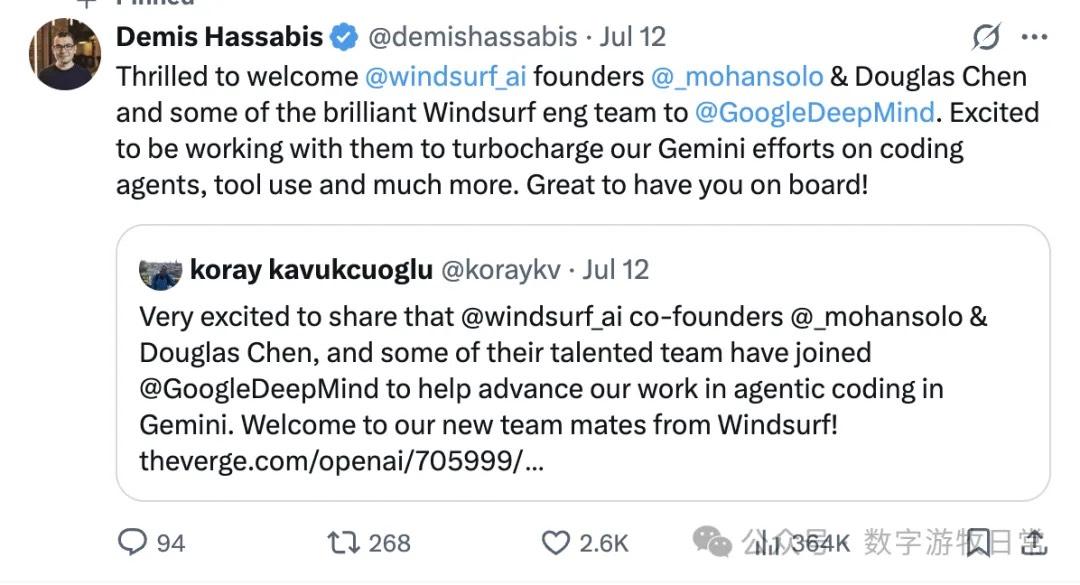
The story is quite dramatic: Windsurf, an AI programming startup (and one of Cursor’s strongest competitors), was originally slated to be acquired by OpenAI for $3 billion. However, for various reasons, the deal was not completed before the deadline. Then, on July 12, Google DeepMind reached a deal with Windsurf reportedly valued at $2.4 billion: Windsurf remains independent, while Google gains non-exclusive use of specific Windsurf technologies. Simultaneously, Windsurf’s CEO, partners, and key members joined the DeepMind team to focus on developing an AI programming IDE based on Gemini.
U.S. media outlets also provided some dramatic "background information": the deal was likely "sabotaged" by Microsoft because OpenAI refused to grant Microsoft the rights to Windsurf’s products and interests. Meanwhile, Windsurf was in direct competition with Microsoft’s GitHub Copilot...
Two years ago, most people would not have imagined that programming IDE tools would become the track with the highest certainty today. Firstly, although Microsoft’s VS Studio, JetBrains (of the Java and Python era), and even earlier tools like UltraEdit (which was "free" for many users for various reasons) were paid software, there were always free alternatives like Vim and Notepad++. Before the current AI wave, Microsoft’s open-source VS Code had already become the standard for programmers, cementing the idea that programming tools should be "free." Secondly, while "feel" was important during the era of manual coding, it was highly subjective. With the vast amount of customizable settings in IDEs, the differentiation between tools was objectively minimal. Many chose niche tools simply out of sentiment or lower system resource usage.
However, things changed with the advent of generative AI. First, although Cursor was born from a branch of VS Code's open-source code, its rapid model integration and the "Tab" (code completion) feature allowed it to quickly break into the mainstream. (While GitHub Copilot in VS Code also had code completion, its product releases were always a step behind). Following the release of Claude 3.5, AI programming suddenly became practical. In the Agent era, Cursor has become a tool that many rely on for their livelihood—even more indispensable than Photoshop.
Cursor hit the mark fastest and most accurately on three points: code completion, Claude 3.5 integration, and Agents. Of course, in this era, the gap between tool-based IDE products won't stay large for long. Soon, Windsurf, Trae, and GitHub Copilot all gained recognition from various user segments.
However, the lack of a massive gap in product features does not mean that programming IDEs have a low barrier to entry. On the contrary, the barrier is quite high. In simple terms, it's about the "feel"—specifically, the fluidity of the experience when humans and AI work together.
The reason Cursor remains the industry benchmark is that Cursor’s biggest users are Cursor themselves: the team generates a massive amount of code every day. The biggest and best users are always the most important foundation and driving force for product iteration.
Of course, powerful competitors have emerged quickly—not just Windsurf, Trae, and Copilot, but those from the model companies themselves: Anthropic’s Claude Code, OpenAI’s Codex, and Google’s Firebase Studio, Jules, and Gemini CLI.
Among them, Claude Code has clearly posed a significant threat to Cursor. The Claude team is a giant in AI code generation, and Cursor’s rapid revenue growth has relied heavily on the Claude model series. Conversely, without the demand for AI programming, the Claude model might have seen far less interest.
Thus, OpenAI moved quickly (actually starting before Claude Code, though Claude Code’s development cycle was incredibly short) to acquire Windsurf.
Google followed suit rapidly, releasing the three tools mentioned above in succession.
Then, a doubling-down Google found the "opportunity" that OpenAI couldn't finalize.
Undoubtedly, Google "merging" Windsurf in this manner is a very positive move. Since the start of this year, Google’s style has changed completely; its actions have become more like those of a true startup. With so many geniuses inside Google, if every individual acted as a "one-person company," it would return to being the giant "product incubator" we were familiar with years ago. Now, the Windsurf team can provide Gemini with many "secret recipes." We might see a Gemini-based programming IDE (the CLI already exists) become highly effective in less than a month.
IDEs represent the most certain demand. But apart from Cursor, this space belongs almost exclusively to a few model companies. In fact, if Cursor doesn't find a "big player" to partner with soon, its future might be uncertain (Anthropic or xAI? I think xAI would be a good fit as they need each other, though I suspect most geniuses wouldn't enjoy working for a "tyrant").
The current state of programming IDEs might tell us a harsh reality: opportunities for model-based applications may truly belong only to the model companies themselves.