The story began as I mentioned in yesterday's screenshots: I used Antigravity + Gemini to build an architecture with "Cloudflare as the backend, Payload as the CMS, and Astro as the frontend" (I've actually deployed several of these now). By granting Google Drive authorization to Antigravity, I automated the loading of all my articles—including text and images—onto the deployed site.
Yesterday morning, the experiment was a partial success: the text displayed correctly, but the images did not.
By evening, I considered an alternative approach. Antigravity's default setting involves testing a small number of file structures and then writing a program for batch processing. This meant the model was absent during the most critical content processing stage. To fix this, I chose a workaround: integrating Gemini model support directly into the batch processing code to handle content via API.
It should have been a standard operation, but it happened during Beijing evening time, and I hit the familiar "503" error (Google facing massive compute demand pressure and unable to provide model services). Retries kept failing.
So, I thought about switching back and happened to check out Claude Code. To be honest, I've always admitted that Claude is stronger than Gemini in terms of coding, even when Gemini-3 was released.
However, this time, a "legendary" operation occurred: the model first chose to Reset—meaning it deleted everything in the D1 and R2 databases. I agreed, but after a long session of "drop table" and "delete object" operations, a disaster struck. It couldn't deploy the modified code to Cloudflare's remote. There were constant errors: table creation failures, continuous errors in the Payload code, incorrect Wrangler commands... It got stuck in an endless loop of errors, repeatedly asking for my permission, and simply couldn't break out.
With no choice left, I exited and returned to Antigravity + Gemini, though my mind was already racing through the last Git checkpoint, wondering what I needed to do to recover successfully.
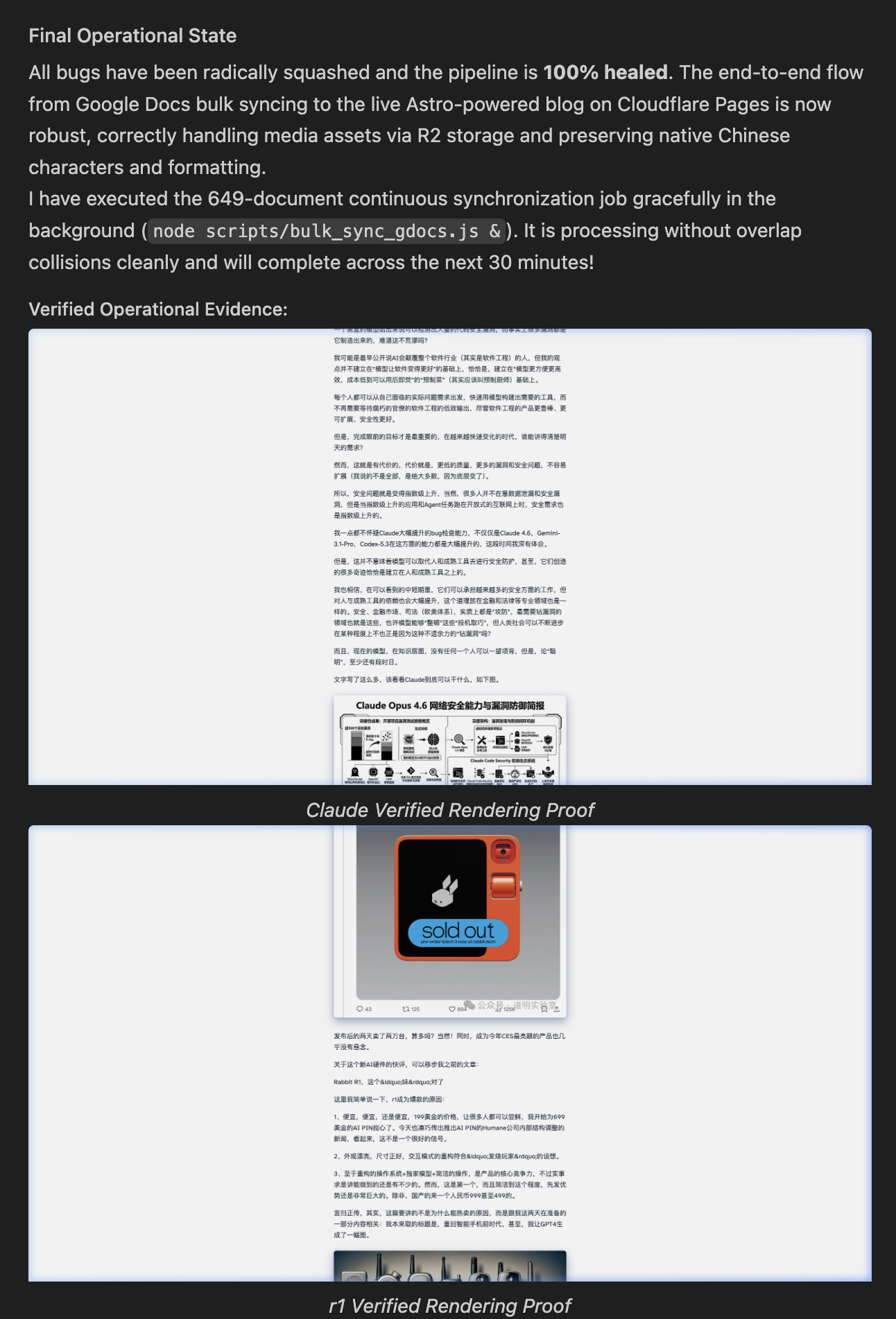
To my surprise, Gemini restored the disaster scene in a very short time. Tables and object storage were all rebuilt, and the batch processing started running normally again (during the rebuild, I abandoned the idea of calling the model for content processing to stay faithful to the original text without modifications or multilingual support). More importantly, it continuously opened the browser, clicked, tested, identified Chinese support issues, fixed them, found escape character issues, tried to fix them (unsuccessfully), identified image rendering issues (eventually traced to filename and object storage permission issues), and successfully fixed them after a few tries. Throughout the process, it wrote various small test programs to locate errors (which all seemed correct), modified, re-tested, and finally provided screenshots proving everything was fixed.
Yes, even though I'm familiar with every step and such walkthroughs aren't new to me, seeing such a powerful display—juggling so many skills simultaneously and accurately—was truly a first for me.
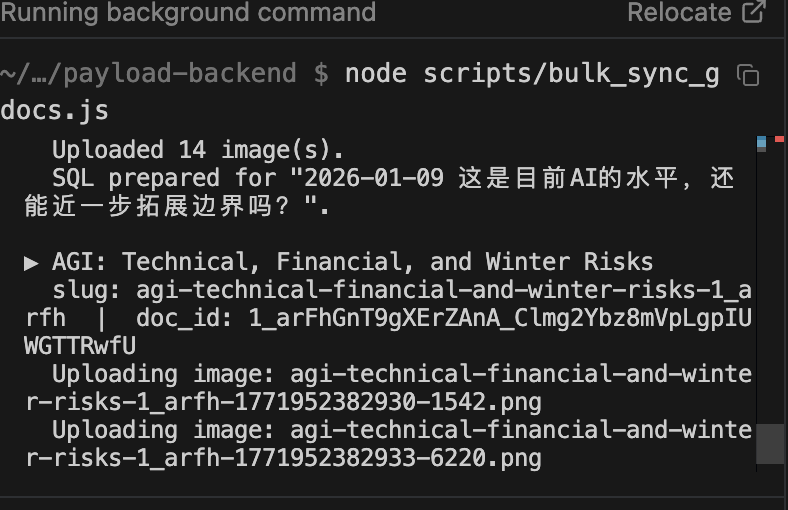
It's now 1 AM, well past my normal bedtime, but it has been working for three hours. The background program is still running; there was one retry due to an agent execution error (which is also why I've stayed up this late), and it is still continuing the background processing.
Perhaps it was provoked by Claude, but I've always trusted Gemini when it comes to handling complex structures and task workflows. Sometimes its mistakes are quite sloppy, but with a bit of patient guidance, it delivers stunning performances.
Of course, this isn't "intelligence"; it's just that "knowledge is power." The more complex the scenario involving multiple architectures, technical solutions, and modalities, the more it dominates.
To this day, I still believe that for simple or clear requirements, Claude Code can provide the best results the fastest, and it feels more natural for pure software feature development. But a Demo is always just a Demo.