
DreamWeaver, Flash, Fireworks—three names that suddenly flashed through my mind, followed by images of ubiquitous books titled "The Web Musketeers." This trio of software, often referred to by that name, hailed from a company called Macromedia.
Flashing back to the year 2000, I suddenly sense a familiar atmosphere:
Web design was becoming the hottest trend;
You could quickly generate web pages with DreamWeaver using a WYSIWYG (What You See Is What You Get) drag-and-drop method without knowing HTML (though after 2000, FrontPage gradually replaced it as part of Microsoft's Visual Studio suite);
In an era when people couldn't distinguish between BMP, JPG, and vector graphics, Fireworks handled all image processing (it was honestly more user-friendly than Photoshop back then);
The long-lived Flash pioneered the animation era. Flash designers then needed a mix of drawing, design, and coding skills—it was easily one of the most lucrative positions;
Back then, as a student with the right to dream infinitely, if I had known that for the next twenty years my most used tools would be Word, Excel, and PowerPoint, I would have questioned my life choices.
Having no concept of economics or finance at the time, I didn't sense the potential consequences of Adobe acquiring Macromedia a few years later in 2005. Today, however, I feel a slight sense of relief at Adobe's failed attempt to acquire Figma.
The rest of the story is well-known. Whether by Adobe's design or the progress of time, DreamWeaver and Fireworks faded. Flash survived the first two decades of the 21st century before exiting the stage (mostly due to the lack of support on the iPhone).
Today, I still miss the feeling of twenty years ago—the thrill and freedom of opening a blank canvas and using tools and code to build an imagined world. A feeling that had nothing to do with money or "other people's goals."
Writing this, I finally realize why the era of the "Three Musketeers" came to mind. It’s like a modern-day callback: even though the AI models and tools we use daily are controlled by a few giants, in their presence, the "Internet that has been boring for twenty years" is finally returning to its original promise: equality and sharing.
I also want to thank the "crazy twenty years" of the financial market and the "dividends of the era." The right to "splatter freely on a blank canvas" has been handed back to more and more people. The difference is that we need a new set of "Musketeers." Twenty years ago, we were building bricks for the web; now, we grow "recklessly" upon that web—breathing, feeding, and existing within it...
This might be a bit abstract. So, here is a historical account provided by "Perplexity Labs" (all text and illustrations were generated by it).
The Web Musketeers: The Golden Age of Web Development Over Two Decades Ago
More than twenty years ago, when the internet was still in its early stages of rapid growth, three software applications shone like stars on the stage of web design and development. They were known as the "Web Musketeers"—Dreamweaver, Flash, and Fireworks [1][2][3]. Originally developed by the American company Macromedia, these tools became indispensable weapons for web creators in the early internet era [1][4][5].
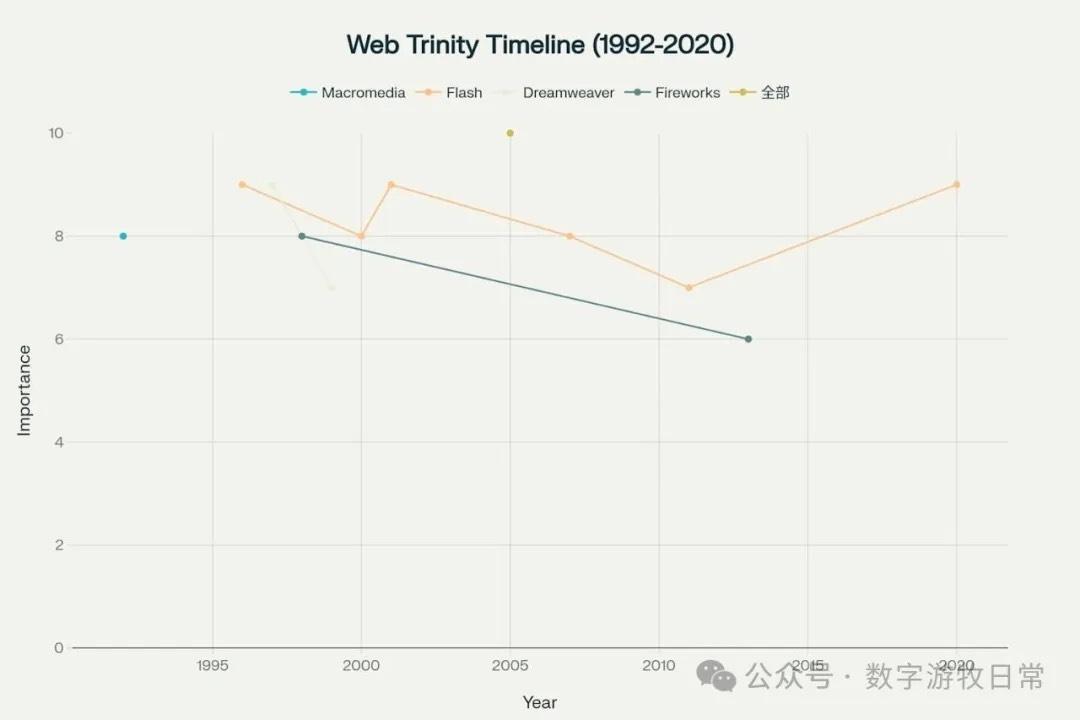
Timeline of the Web Musketeers: From the Birth of Macromedia to the End of Flash
Historical Background and Corporate Evolution
The Birth and Growth of Macromedia
Macromedia was founded in 1992 through the merger of Authorware Inc. and MacroMind-Paracomp [4][5][6]. Its core product, Director, was initially a multimedia authoring tool that laid the technical foundation for Flash [4][6]. With the rise of the internet, Macromedia pivoted toward developing multimedia tools suited for web environments [5][6].
In 1995, the company launched Shockwave Player, the first plugin capable of displaying interactive content in a browser [4][6]. That same year, Macromedia acquired Altsys Corporation, gaining the vector drawing program FreeHand, which provided the technical basis for the development of Fireworks [4][5].
The Turning Point: Adobe Acquisition
On December 3, 2005, Adobe Systems acquired Macromedia for $3.4 billion, marking a significant turning point for the Web Musketeers [4][7][8]. This acquisition changed the trajectory of the three software products and redefined the landscape of digital creative tools [7][8].
Detailed Breakdown of the Web Musketeers
Dreamweaver: The WYSIWYG Web Editing Revolution
Launched in 1997, Dreamweaver was a revolutionary web development tool [1][2][8]. Its greatest innovation was providing a "What You See Is What You Get" (WYSIWYG) visual editing environment, allowing designers unfamiliar with HTML code to create websites easily [1][3][9].
Dreamweaver 3.0, released in 1999, is considered a classic version. With a file size of less than 3MB, it was extremely fast and feature-complete [8]. It integrated web authoring and site management, becoming the go-to tool for web designers [1][8].
Flash: The Pioneer of Animation and Interaction
Flash's history dates back to 1993, originally called SmartSketch. In November 1996, Macromedia acquired FutureWave and renamed the product Macromedia Flash 1.0 [7]. Flash’s greatest technical advantage was its use of vector graphics, resulting in small file sizes ideal for the narrow-band internet of the time [1][11].
Flash holds a special place in the history of the Chinese internet [12][13]. In 2000, Jiang Jianqiu's "Rock 'n' Roll on the New Long March" became a milestone in Chinese Flash animation, marking the rise of the "Shanker" (Flash creator) culture in China [12][13].
Fireworks: Image Processing Born for the Web
First released in 1998, Fireworks was image processing software specifically developed for web design [1][2][14]. It focused on creating and optimizing web graphics, specializing in the JPG and GIF formats commonly used online [1][2]. It supported both vector and bitmap editing and integrated seamlessly with Dreamweaver and Flash [1][15][14].
Glory of the Golden Age
- Lowering Technical Barriers: The Musketeers made "visual operation" possible, allowing designers to focus on creativity rather than learning complex programming [2][16].
- Rise of the Shanker Culture: Creators used Flash for artistic expression. In 2001, Zhu Zhiqiang's "Xiao Xiao No. 3" became a martial arts Flash classic, setting a domestic record for clicks at the time [12][13].
- Popularity of Education and Training: Many universities and training institutions offered courses on these tools, cultivating a generation of web design talent [19][20].
Changing Eras and Technical Evolution
The Impact of the Mobile Internet
The launch of the iPhone in 2007 was a critical turning point in the decline of the Web Musketeers [7][18][22]. Steve Jobs famously stated that Apple devices would not support Flash. As mobile devices became ubiquitous, Flash's market position plummeted [22].
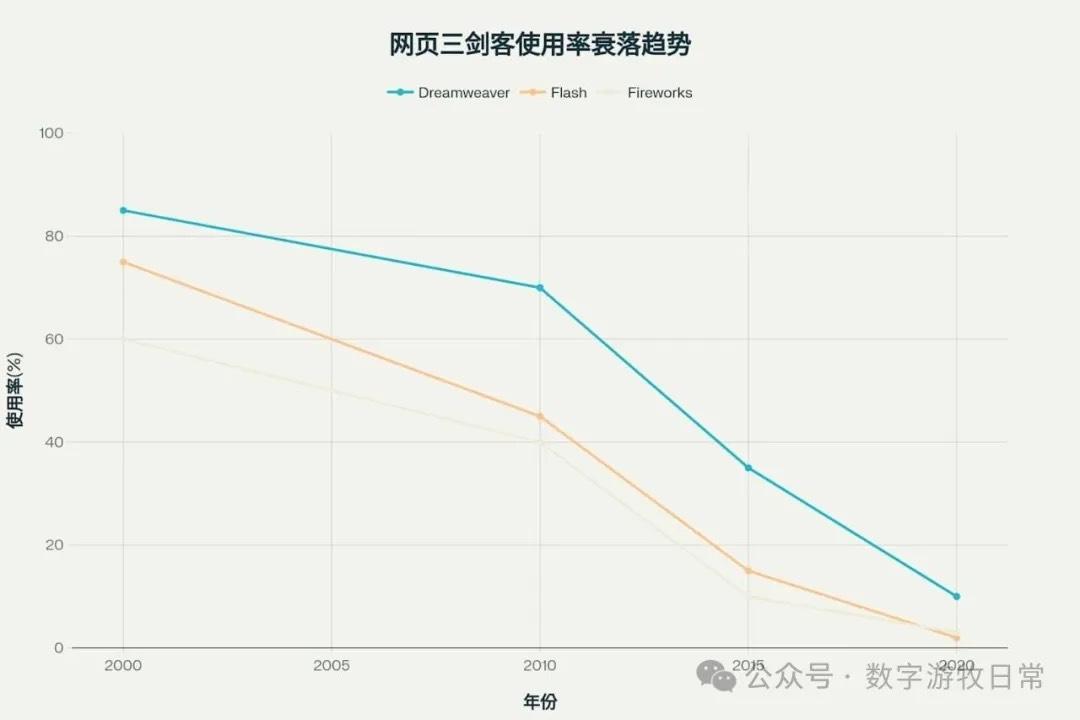
The Decline of the Web Musketeers: From Golden Era Tools to Technical History
The Rise of HTML5 and Modern Technologies
HTML5 provided a technical alternative to Flash [11][23][24]. Modern front-end development tools like VS Code and WebStorm far exceed Dreamweaver in functionality and performance [26][25].

Web Development Evolution: From the Easy-to-Use Musketeers to Professional Modern Development
The Final Curtain
- Official End of Flash: On December 31, 2020, Adobe officially stopped updates and support for Flash Player [7][29].
- Discontinuation of Fireworks: In 2013, Adobe announced it would stop developing new features for Fireworks [30][14].
- Usage Plunge: Dreamweaver's usage fell from 85% to 10%, Flash from 75% to 2%, and Fireworks from 60% to 3%.
Historical Significance and Modern Inspiration
The most important legacy of the Web Musketeers is the democratization of web creation technology [2][16][31]. This philosophy of "lowering the barrier" is inherited by today's low-code and no-code platforms [31].
Conclusion
The Web Musketeers witnessed the key period of the internet moving from its infancy to prosperity [17][33]. Though the tools have exited the stage, the innovative spirit they represent will forever remain in internet history.
⁂

- https://baike.baidu.com/item/网页三剑客/1414859
- https://blog.csdn.net/yilaguandemei/article/details/79137858
- https://www.cnblogs.com/ai888/p/18667987
- https://en.wikipedia.org/wiki/Macromedia
- https://www.computinghistory.org.uk/det/66554/Macromedia-Inc./
- https://www.encyclopedia.com/books/politics-and-business-magazines/macromedia-inc
- https://zh.wikipedia.org/zh-cn/Adobe_Flash
- https://www.cnblogs.com/jsjblc/p/3568927.html
- https://www.mockplus.cn/blog/post/1105
- https://pixso.cn/designskills/dreamweaverruanjian/
- https://time.geekbang.org/column/article/9298
- https://zh.wikipedia.org/zh-sg/閃客
- https://www.gmw.cn/01ds/2002-04/24/15-FB5A400652D36EBA48256BA50006D3AC.htm
- https://www.douban.com/note/323030827/
- https://helpx.adobe.com/nz/dreamweaver/using/cross-application-integration.html
- http://www.xinanhl.com/list_28/209.html
- https://blog.csdn.net/u013350495/article/details/125984528
- https://www.sumaarts.com/share/1334.html
- https://cnki.huanghuai.edu.cn/KCMS/detail/detail.aspx?filename=DDJY201405017&dbcode=CJFR&dbname=
- http://gdii.gd.gov.cn/rcgh/content/post_945897.html
- https://www.hxsd.com/ztkc/wysjpx0513/
- https://blog.csdn.net/weixin_35294091/article/details/147435737
- https://www.sohu.com/a/564882009_121363584
- https://docs.pingcode.com/baike/3001581
- https://blog.csdn.net/m0_57344393/article/details/139849262
- https://www.cnblogs.com/xiongwei/articles/18728291
- https://juejin.cn/post/6911582217316204557
- https://blog.csdn.net/xybhua/article/details/127341697
- https://news.43zhubao.com/n/46418.html
- https://gori.me/it/31672
- https://www.west.cn/docs/157353.html
- https://segmentfault.com/p/1210000046709182
- https://www.cernet.com/hlw30/202409/4805.html