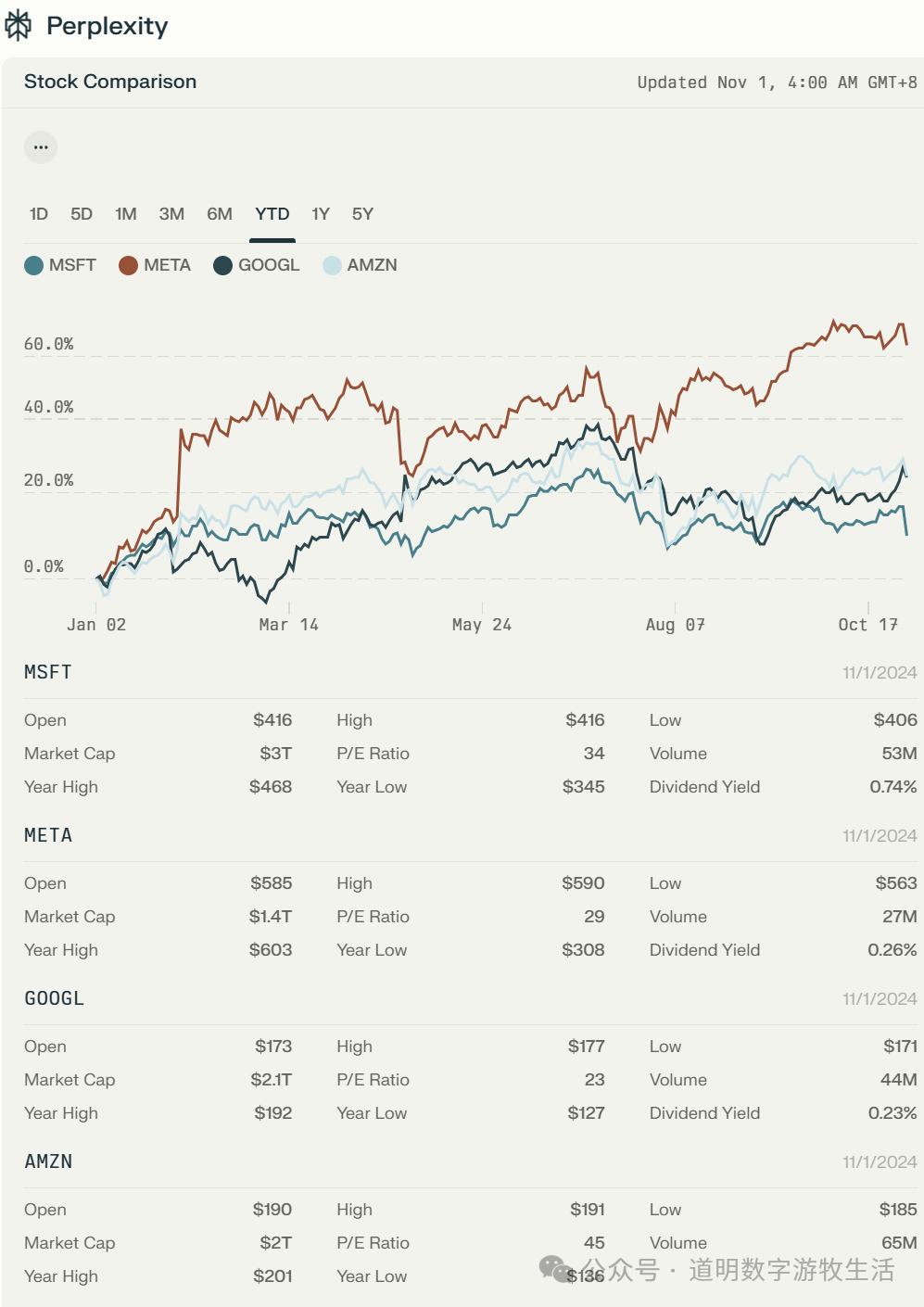
As of the morning of November 1, 2024 (Beijing Time), it is a super earnings week. Five of the "Magnificent Seven" tech giants have released their earnings reports this week. Of the remaining two, Tesla released its earnings earlier, and Nvidia typically follows in late November.
Objectively speaking, Google’s report showed cloud growth and overall profit growth significantly exceeding expectations. Microsoft and Meta both beat expectations, but the market was dissatisfied with their "future guidance." Amazon’s report could be described as mediocre, yet the market has shown positive feedback toward its "future guidance."
This is a clear double standard. It illustrates the extreme chaos of the market: as long as there is intent, reasons for optimism or excuses for pessimism can always be found.
In fact, the trajectories of these four companies this year have vividly reflected this "chaos."
Why did investors who bet on Microsoft and Meta "beating expectations" turn out to be factually correct but suffer huge losses the next day? Why has Microsoft, which seemed better positioned in AI strategy and actual financial performance over the past year, been the worst performer among the four?
Is "fundamental research" wrong?
On the surface, of course not:
- Google performed well because its cloud growth and profit growth both far exceeded expectations—very fundamental.
- Although Amazon's performance was mediocre, its outlook was optimistic—very fundamental.
- While Microsoft beat all market expectations slightly, its growth outlook for cloud business showed a quarter-on-quarter decline—also very fundamental.
- While Meta's earnings were good, its "aggressive" capital expenditure still fails to demonstrate corresponding AI revenue prospects—even more fundamental.
However, these are fundamental-level explanations based on market performance rather than fundamental facts that can be used for investment decision-making.
The market this year—whether involving the "betting" on AI and tech, the fluctuations in "interest rate cut expectations," or even the recent "front-running" of election results—tells us a harsh reality: if accurately predicting a future event (financial performance, rate cut magnitude, etc.) is what constitutes "fundamental research," then for over 99.99% of market participants, it is meaningless:
- Everyone knows the importance of data, but in the face of "authority," we don't even have the standing to "question" the data.
- In today's highly developed social media era, all new information travels globally in the shortest time; almost all participants are receivers and "middlemen" of information.
- The trading value of information decays rapidly within minutes, waiting for the next piece of "new information" to cause volatility.
In reality, for at least the past several decades, stock prices falling after optimistic earnings or prices moving against expectations upon fulfillment has been the market norm. What has truly changed are the three points above:
"True information sources" are held by a very few. Social media has provided an overwhelming advantage for information dissemination under the guise of "fairness," making "professionals" and "ordinary people" the same. "Professionals" are increasingly becoming legalized "information middlemen" and "noise makers."
The problem is that anyone can access the original source of these "second-hand information" and "noise" at zero cost.
For uncertain events occurring at a fixed short-term time—such as earnings, data, or policy decisions—the only thing one can do is "strategic response." On this front, machines have already far surpassed humans. Whether calculating odds for different scenarios or rapid position adjustments under market movement, algorithms have at least dominated mainstream overseas markets.
As for the so-called short-to-medium term of one to three months within market volatility, most incremental investment value is eroded by short-term swings. Truly meaningful research lies more in long-term holistic thinking based on "first principles" and logic. From this perspective, one can see the considerations behind the performance of these four companies:
- In Google’s cloud growth, the increase in service subscriptions based on the Gemini ecosystem played a huge role. The models are their own, application integration is excellent, and the growth is stable. Meanwhile, the costs behind these services largely correspond to their own TPU computing power, which is not only controllable but also maximizes utilization.
- Microsoft certainly benefits greatly from OpenAI, but its GPU computing power is occupied by OpenAI and other large enterprises, leading Microsoft to constantly claim "strong demand but limited capacity." Against the backdrop of Office Copilot repeatedly falling short of expectations, Microsoft’s "cloud service" acts as long-term contracts for clients, offering almost no elasticity compared to Google and Amazon.
- Meta is very aggressive in its AI strategy with heavy capital expenditure and the "open-weight" LlaMa model. However, Meta has no visible scenarios for generating revenue from AI services, and won't for a long time. I admire Zuckerberg’s personal leadership and Meta’s boldness, but advertisement revenue and AI application implementation are not inherently consistent.
- Amazon has the best cloud service ecosystem. in an era where models are not scarce, a neutral one-stop cloud service (no worry about competing with the cloud provider, no concern for data security and privacy, and easy service migration) will be the preferred choice for enterprise users.
These long-term factors have persisted throughout the year and appear to be the most important fundamental factors affecting stock performance; however, these are all "hindsight."
Unfortunately, under the "path dependency" of trying to create a high-frequency impression of "it always happens as I expected, I am always right"—regardless of whether one is a first-hand source or was correct before—these long-term reasons are often dismissed as "irrelevant."
They are not as instantly accessible as fast food, and their accuracy is shockingly low.
In business, choices are easy to make. One just has to endure the increasingly competitive results.
PS: Today is not like yesterday; the market is clearly concerned with the "business transparency" of tech companies—not a matter of information disclosure, but the "visibility" of the business itself.