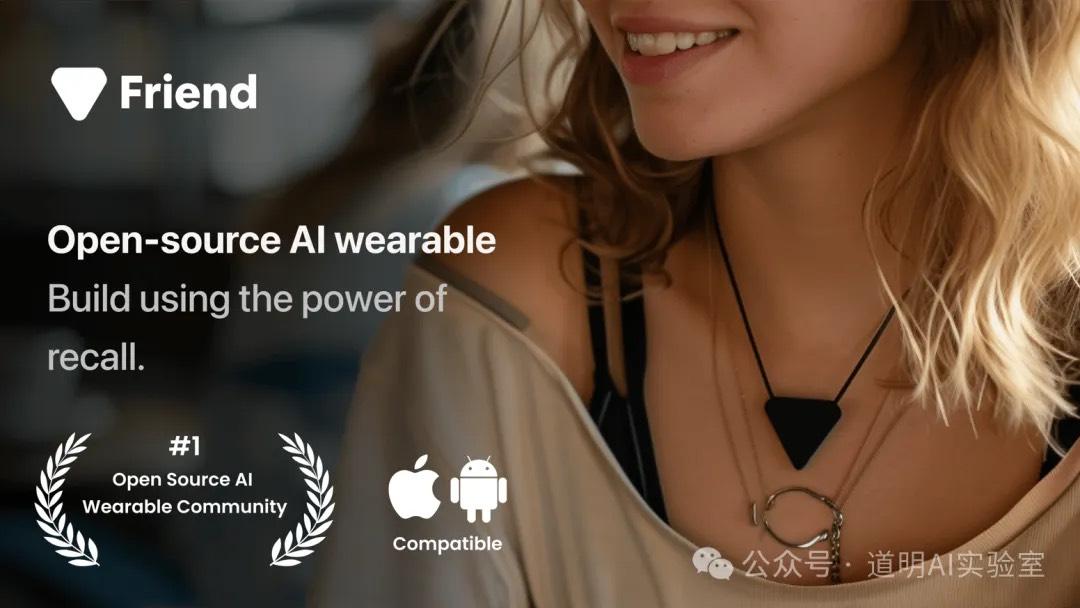
If there were a wearable AI hardware that was compact enough to carry anywhere, yet could connect to my "personal data center" to help me receive and process information, aid my memory, and assist in my daily life and work—
I might need that. I just came across another new piece of AI hardware with a pleasant name: Friend. It is an AI necklace, open-source, connects directly to a smartphone, and features localized data storage.
As shown, the more primitive development kit version is $68, while the more futuristic-looking necklace pictured below is $97.

If it were just for personal use, I would be very willing to try it:
- It's compact enough to carry at all times.
- It records audio continuously, which can then be processed by AI models for meeting minutes, important reminders, and various other possibilities. In an era where the concept of a "Second Brain" is becoming increasingly popular, the "core demand" for such applications definitely exists.
- In the age of AI models, what everyone technically needs is an information collector, a model, and an information display device. A "necklace" like this is worth a shot.
- At the very least, it eliminates the need for a voice recorder.
Of course, the potential issues are quite obvious:
This product is actually very "aggressive." While I might be willing to have my own voice recorded, it doesn't mean friends talking to me face-to-face would be—in fact, they would likely be quite unwilling. Essentially, this is no different from "surveillance."
Such a product likely won't sell many units. Although it's cheaper than the Rabbit R1, the sales volume will probably be much lower.
However, it poses an excellent question: while AI models provide more and more possibilities, where is the line we are willing to accept? To what extent are we willing to let it invade our "territory"?
That said, we who once unhesitatingly gave up our phone numbers and addresses for home delivery, and surrendered our identity and biometric information to register accounts, might continue to lower our standards if given the chance to become more efficient.
The fairness of AI might not be an issue of supply, but rather an issue of the fairness of our "bottom lines."